Choosing large cat tree platforms: the dimensions big cats need starts with your cat’s own measurements, not a breed label or a tree’s advertised height. Compare the space your cat can actually use with its resting posture, climbing route, and the stability of the whole structure.
Key Takeaways
- Measure before you compare. Record your cat’s curled length and width, standing stretch, and shoulder height.
- Check usable perch area. Posts, raised edges, toys, and hammocks can take up space inside a platform’s outside dimensions.
- Assess the whole tree. Base footprint, height, weight capacity, post thickness, and joint stability all affect how secure a tree feels during movement.
- Plan an accessible route. Staggered levels and clear landing areas help cats climb without relying on one difficult leap.
- Fit the tree to the room. Account for overhead clearance, floor space, approach paths, and delivery access.
- Our cat furniture guides cover other ways to plan a comfortable indoor space for your cat.
Measure your cat’s resting and stretching positions
Start with the cat, not the cat tree. A platform that looks generous in a product photo may feel cramped to a cat that likes to curl tightly, while a broad-looking perch can still be a poor match for a cat that sprawls.
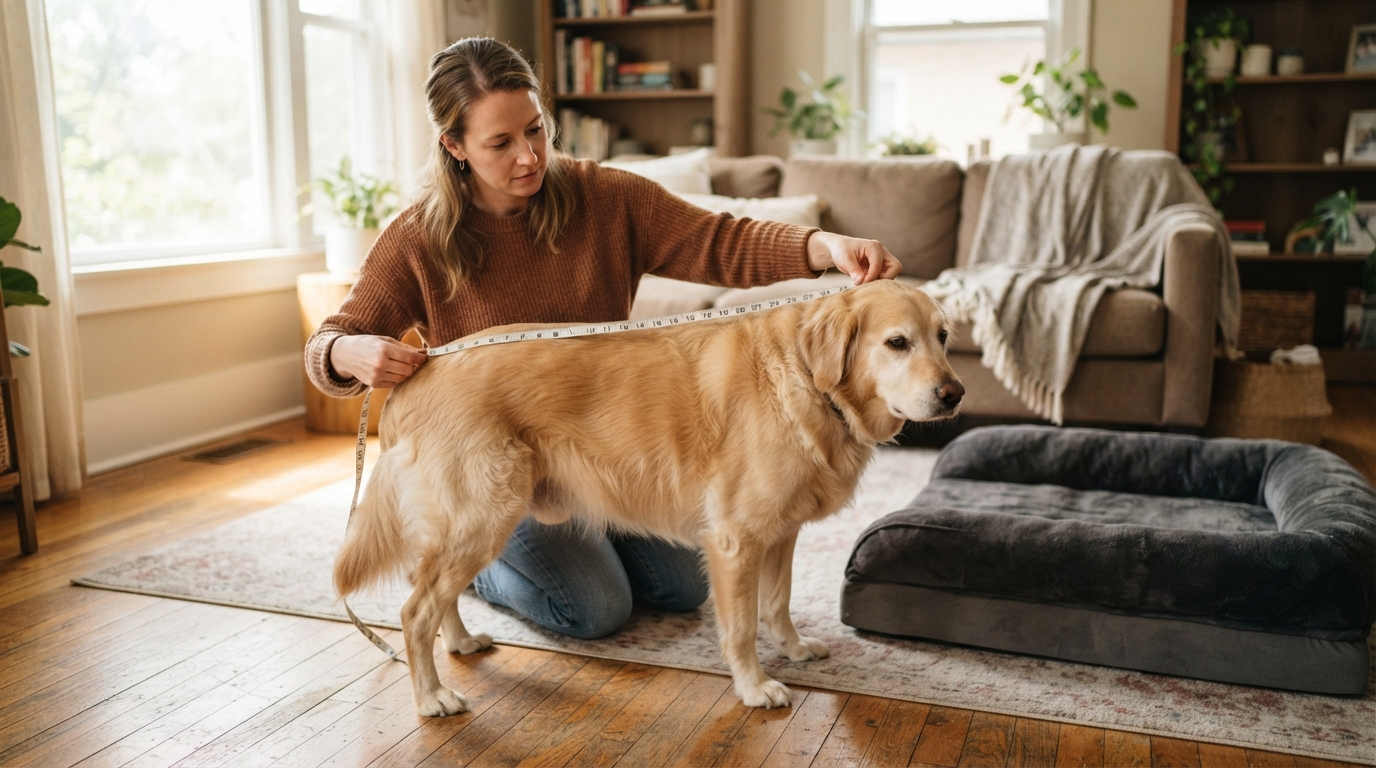
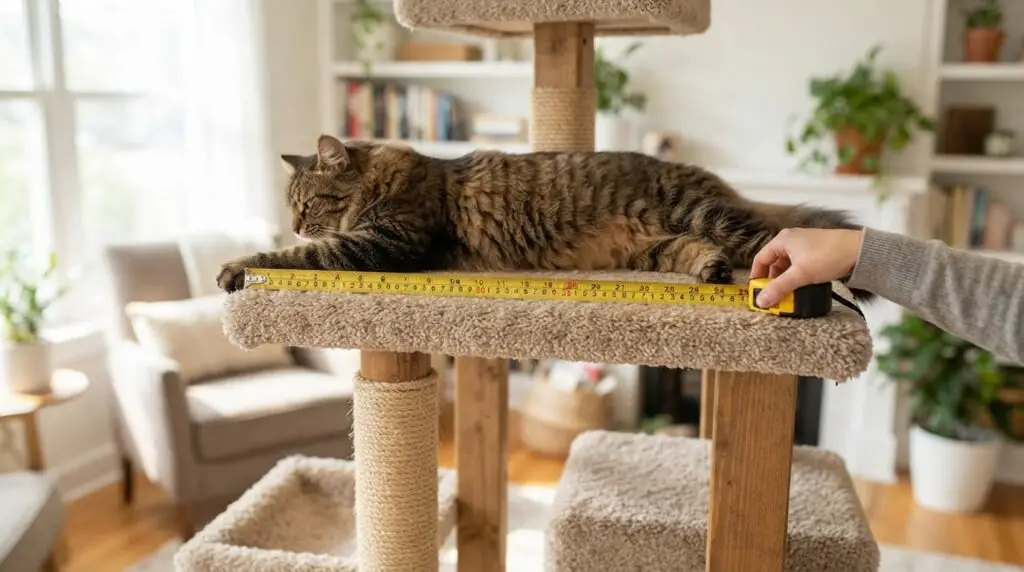
Measure your cat in its usual sleeping position, noting the full curled length and width. These measurements help you judge whether a cat tree platform can hold the posture your cat prefers without its body hanging over the edge.
Then measure your cat standing and fully stretched. Record its shoulder height and how far it reaches, since those measurements help you assess whether a scratching post and the route between levels let your cat extend naturally.
Write down which surfaces your cat actually uses: open perches, enclosed beds, or hammocks. A large outside measurement is less useful if your cat avoids that type of resting spot.
Consumer Reports describes a large cat as one weighing over 10 pounds and says its tree should be sturdy enough to support it. Use weight as a prompt to assess sturdiness, not as a substitute for measuring your individual cat.
| What to record | How to measure it | What it helps you judge |
|---|---|---|
| Curled length | Measure the cat in its usual sleeping curl from end to end. | Whether a bed or perch can hold its preferred resting posture. |
| Curled width | Measure across the widest part of the curled body. | Whether the cat can settle without being crowded by a post or edge. |
| Standing stretch | Measure the cat fully extended in its usual stretching position. | Whether a scratching post offers room for a natural stretch. |
| Shoulder height | Measure from the floor to the top of the shoulders while standing. | How the cat’s size relates to post height and access between levels. |
Keep the measurements together as a simple worksheet. Compare them with each surface your cat uses, rather than choosing a tree by breed name alone.
Compare usable perch area, not just outside dimensions
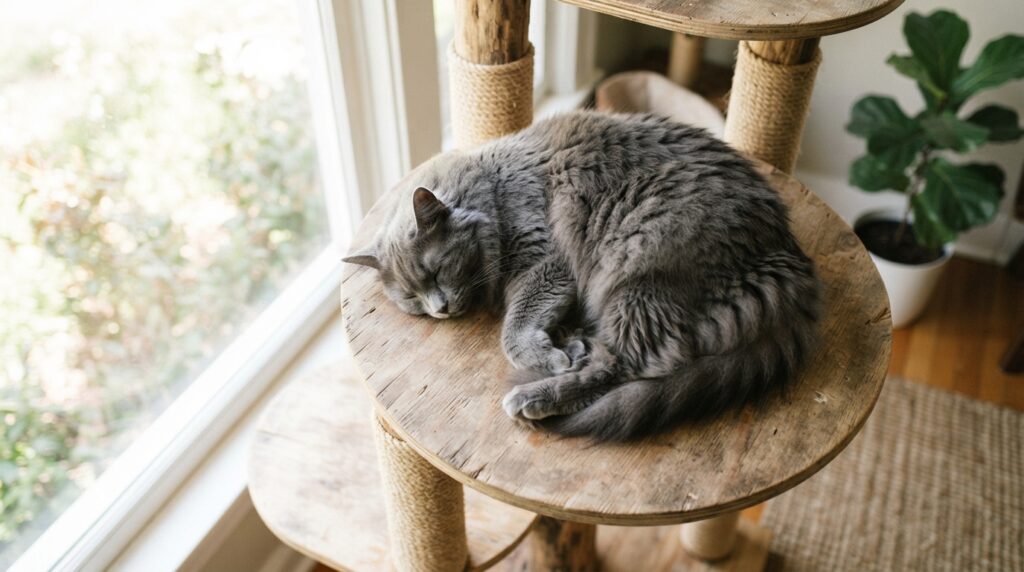
The usable perch area is the clear surface your cat can occupy, not the platform’s widest listed measurement. Check where posts meet the platform and whether a raised lip, attached toy, or hammock reduces the open space.
Compare that unobstructed area with your cat’s curled measurements. The cat should be able to settle into its preferred position without being pushed into a corner by a post or crowded by nearby features.
For a cat that sprawls, prioritize a broad, continuous resting surface. The longest outside edge alone does not tell you whether the cat can stretch across the platform without running into a support or losing space to an attachment.
Look underneath the perch, too. A wide platform needs support across its span; if it flexes noticeably when your cat shifts position, the extra surface area may not feel secure.
In a multi-cat home, consider the usable space on every level as part of the layout. Separate resting spots let one cat settle without blocking another cat’s route or claiming the only comfortable perch.
Judge the base and weight capacity together
A tall tree needs a base that can resist movement. Compare the base footprint with the overall height: a broad, stable base generally offers more tip resistance than a tall, narrow structure.
Read the weight capacity in context. A stated limit may apply to the whole tree or to one platform, and those are different claims; a static weight figure also does not describe the extra force of a cat jumping onto a perch or moving across it.
Look for secure connections between the base, posts, and platforms. Where the design and room placement allow it, an anti-tip strap or wall anchoring can add another layer of stability.
After assembly, apply gentle pressure to the structure and watch for wobble. Repeat the check during regular use, and stop using the tree if it becomes unstable until you correct the connections or anchoring.
Large cats need a sturdy tree that can support their weight.
Source: Consumer Reports
Weight capacity is one part of the decision, not a complete measure of safety. For cat furniture for large cats, consider how the whole structure behaves when your cat climbs, turns, and lands.
Choose height and level spacing for safe access
How tall should a cat tree be for a big cat? Choose a height that suits your cat’s climbing ability and the room’s available clearance; height by itself does not make a tree a good fit.
Pay attention to level spacing and the route between platforms. Staggered perches allow a cat to climb in shorter steps instead of relying on one large leap, which can be especially helpful for a heavy, hesitant, or less agile cat.
Check each transition for a clear landing area. A route becomes awkward when the cat has to squeeze around a post, hammock, or toy to reach the next level.
For a cat with joint problems or limited mobility, prioritize low resting places and easy step access over maximum height. If your cat’s movement has changed, ask your veterinarian about safe activity and climbing rather than expecting a tall tree to suit every ability.

Inspect posts, joints, and scratching surfaces
Look for thick, firmly secured posts on the parts of the tree your cat will climb or scratch. A post that flexes can make the entire route feel unstable, even when the platforms themselves look substantial.
Check where posts meet the base and platforms. Secure fasteners and well-supported joints matter more than a large perch attached to a weak connection.
Construction materials affect how a tree stands up to repeated use. Sisal-wrapped posts provide a coarse, fibrous scratching surface, while carpeted posts offer a textile texture; for the load-bearing frame, sturdy wood or plywood usually gives fasteners a firmer hold than thin particleboard.
Choose a scratching post that gives your cat room to extend against it. When a cat has to brace awkwardly or pull hard on a narrow post, the repeated force can work against the tree’s stability.
Retighten fasteners as needed, and inspect joints, post coverings, and the base for looseness or wear. Address new wobble promptly instead of waiting for a part to fail.
Fit the tree to the room and the household
Measure the floor area for the base and the overhead clearance for the tree’s tallest point. Leave a clear route for your cat to approach and leave the setup, rather than fitting the base into a space that blocks everyday movement.
Think through the path from the entrance to the chosen room. Turns, narrow doorways, and stairways can affect whether the assembled tree or its separate components will reach the space.
For a multi-cat layout, look for more than one usable resting place and avoid routes that force cats through one narrow bottleneck. A tree should work for the household’s movement patterns, not just fit the floor plan.
Consumer Reports considers cats senior at 10 years old. Age is one consideration, but pay attention to your cat’s actual movement: lower steps and easy access matter most when mobility changes.
Small rooms still need a clear climbing route. If a broad base would crowd the floor, compare the space it saves with the access and stability the cat needs before choosing a more compact arrangement.
Frequently Asked Questions
Is there a standard platform size for an XXL cat tree?
There is no single standard platform size used across XXL cat trees. Labels such as XXL can help you narrow options, but your cat’s measurements and resting posture are a more useful way to compare platforms.
Can a large cat safely use a hammock on a cat tree?
A large cat can use a hammock when its supports and attachment points are designed for the cat’s weight and remain secure in use. Watch how the hammock moves as your cat gets in and out, since that can affect whether it feels comfortable using it.
How many resting platforms should a large cat tree have?
There is no fixed number; choose a layout with enough places for your cats to settle comfortably.
How can I help a large cat get used to a new, taller tree?
Let your cat investigate the tree at its own pace, and reward calm exploration with treats or a familiar toy. You can also encourage short play sessions around the lower levels before inviting your cat to explore higher areas.
Where should I place a cat tree so a large cat feels comfortable using it?
Choose a spot where your cat can observe familiar household activity without being in the middle of a busy walkway. A location that gives the cat a clear view of the room and a comfortable way to leave can make the tree feel more inviting.
Conclusion
The best large cat tree platforms are sized around the cat that will use them. Measure curled length and width, standing stretch, and shoulder height, then compare those figures with the usable perch area, climbing route, base footprint, and support.
Large Cat Tree Platforms: The Dimensions Big Cats Need are not defined by one breed label or a single outside measurement. Choose a tree that gives your cat room to rest and stretch, a stable route between levels, and a layout that works in your home.