Cats and Christmas trees can share a home more safely when you limit easy launch points, secure the whole setup, and give climbing behavior a better target. The right plan depends on your room, your tree, and what your cat tends to chew, bat, or climb.
Key Takeaways
- Choose a spot away from furniture and shelves your cat could use to jump onto the tree.
- Check the trunk fit, base, and anchor together, then test stability before decorating.
- Keep tinsel, dangling decorations, accessible cords, tree water, and fallen debris out of reach.
- Real and artificial trees have different hazards, but neither is automatically a cat-safe Christmas tree.
- Use a closed room or a secure barrier when you cannot supervise, and treat deterrents as backup.
- Offer a climbing alternative away from the tree, with a route and location your cat will actually use.
Choose a spot with fewer launch points
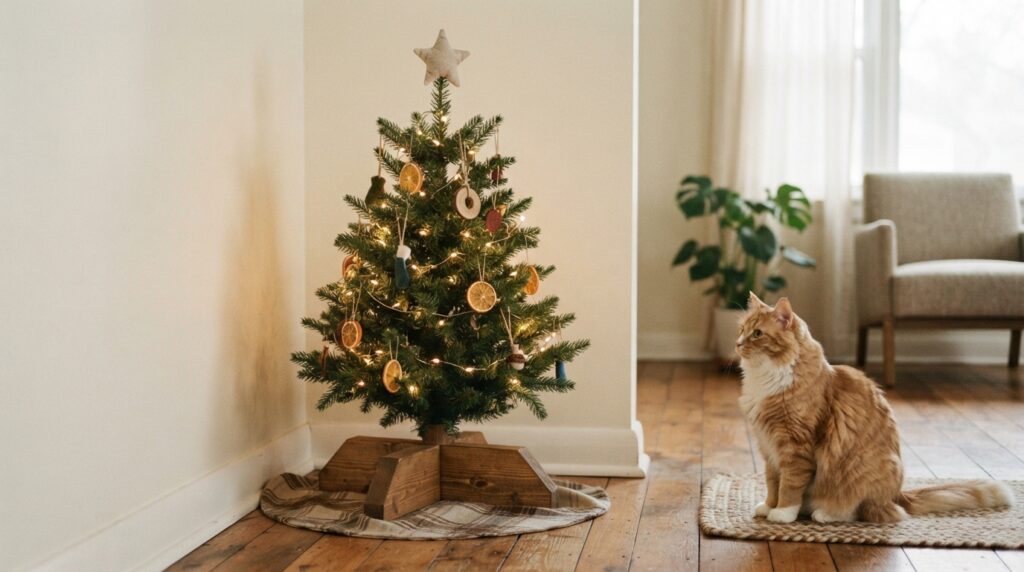
Place the tree away from sofas, shelves, counters, and window sills that could give your cat an easy route onto the branches. A tree beside a favorite jumping spot is harder to protect because the cat can reach it without climbing from the floor.
Avoid narrow walkways and doorways where a startled cat could collide with the tree or knock it over while passing. Leave enough space to walk around the setup, and keep your cat’s usual routes clear so it doesn’t have to squeeze past ornaments or cords.
Choose a location where you can close a door or set up a stable physical barrier when you’re away or unable to supervise. A tree skirt or decorative screen may hide the base, but it won’t reliably block a cat that can climb or jump over it.
Match the stand to the tree and anchor it
A stable tree needs a stand that fits the trunk securely and suits the tree’s size. If the trunk shifts inside the stand, the tree can tilt even when the stand itself feels heavy.
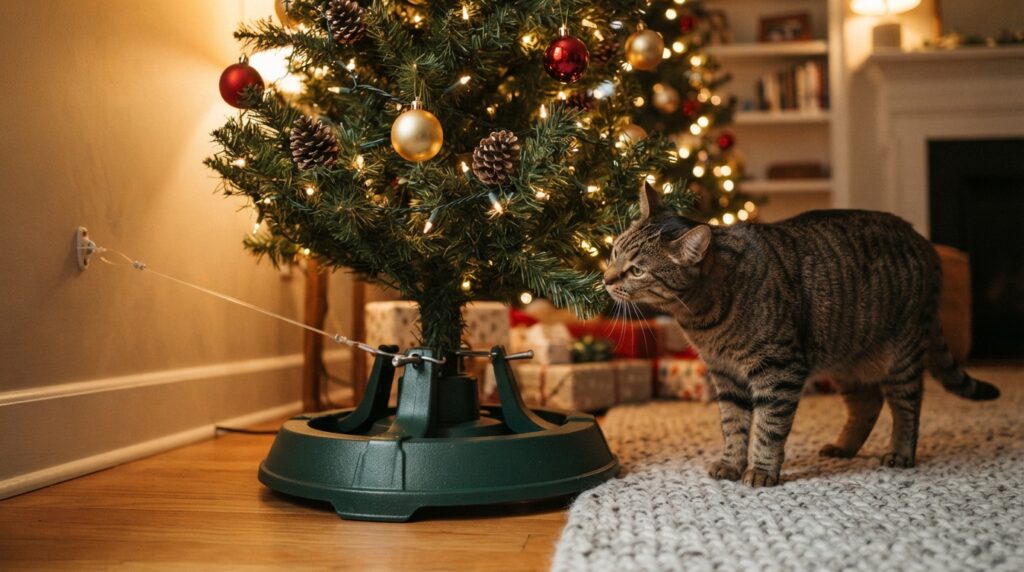
Look for a broad base with a firm grip on the floor, then anchor the upper part of the tree to a secure wall point using suitable hardware or fishing line. Keep any line taut and out of your cat’s reach; a heavy stand alone is not a substitute for tree anchoring.
Before adding lights or ornaments, gently test the tree from more than one direction. The trunk should stay upright, and the stand should not rock or slide across the floor.
Recheck the stand and anchor after the tree has been bumped, moved, or watered. Even a setup that feels firm at first can shift during everyday use.
Keep tempting decorations and hazards out of reach
Skip tinsel and ribbon, which cats may swallow, and keep small, breakable, edible, or dangling decorations off lower branches. A swinging ornament can look like a toy, so fasten decorations securely rather than leaving them to move freely.
Use shatter-resistant ornaments on reachable branches, and place fragile decorations higher up where your cat cannot bat or chew them. Avoid hanging tempting items near a chair, table, or other surface the cat can use to reach the upper branches.
Route lights and cords out of reach, and use a cord protector where you can’t keep a cord fully hidden. Unplug the lights when the tree is unattended; cord chewing can cause serious injury and needs urgent attention.
Cover the tree-water reservoir so your cat can’t drink from it, and keep any water additives inaccessible. Sweep up fallen needles and pick up broken ornament pieces promptly to reduce opportunities for chewing or swallowing them.
Compare real and artificial trees without assuming either is cat-proof
A real tree can drop needles and leave accessible water in its stand. Cover the reservoir, prevent your cat from drinking from it, and clean up fallen needles as they appear.
An artificial tree avoids the water reservoir, but it can still tip, shed pieces, or expose wires that a cat may chew. Inspect its branches and electrical parts, secure the tree, and keep chewable components out of reach.
The material is only one part of the decision. Placement, anchoring, decoration choices, and your individual cat’s behavior matter with either kind of tree.
The American Christmas Tree Association reports that 83% of households planning to display a Christmas tree this season will choose an artificial one. That describes household choice, not proof that an artificial tree is automatically safer for cats.
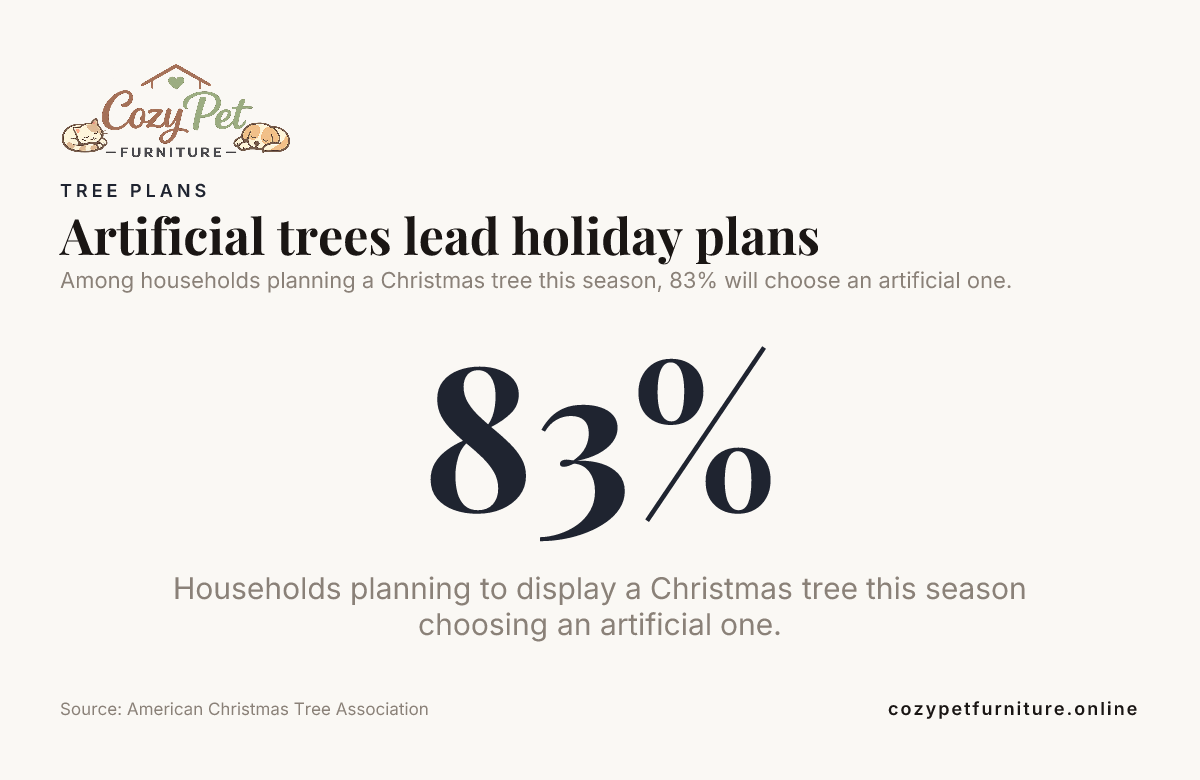
Among households planning a Christmas tree this season, 83% will choose an artificial one.
Use barriers as backup, not as the whole plan
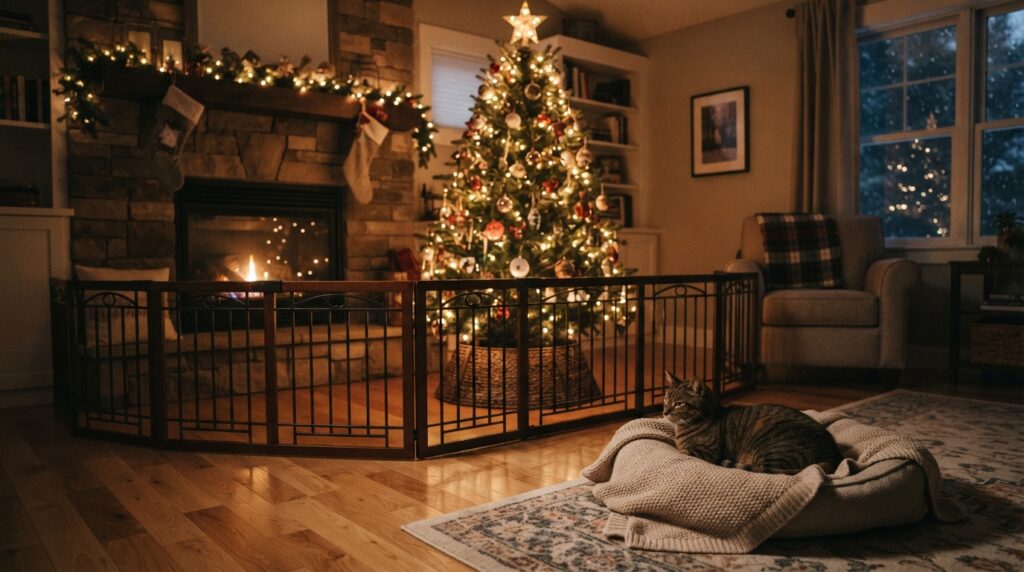
A closed room or a stable barrier that blocks the route to the tree changes access more reliably than a low screen a cat can jump over or walk around. If you use a barrier, consider whether your cat can climb it, push it aside, or reach decorations through it.
A motion-activated deterrent can add another layer, but it shouldn’t frighten your cat into a jump or collision. Avoid applying scented products or essential oils around the tree unless a veterinarian has confirmed that the specific product is safe.
Introduce the tree gradually, supervise your cat’s early visits, and reward calm behavior nearby. If your cat keeps trying to climb, change how it can access the tree and offer a more appealing climbing option.
Redirect climbing with a compact cat tree
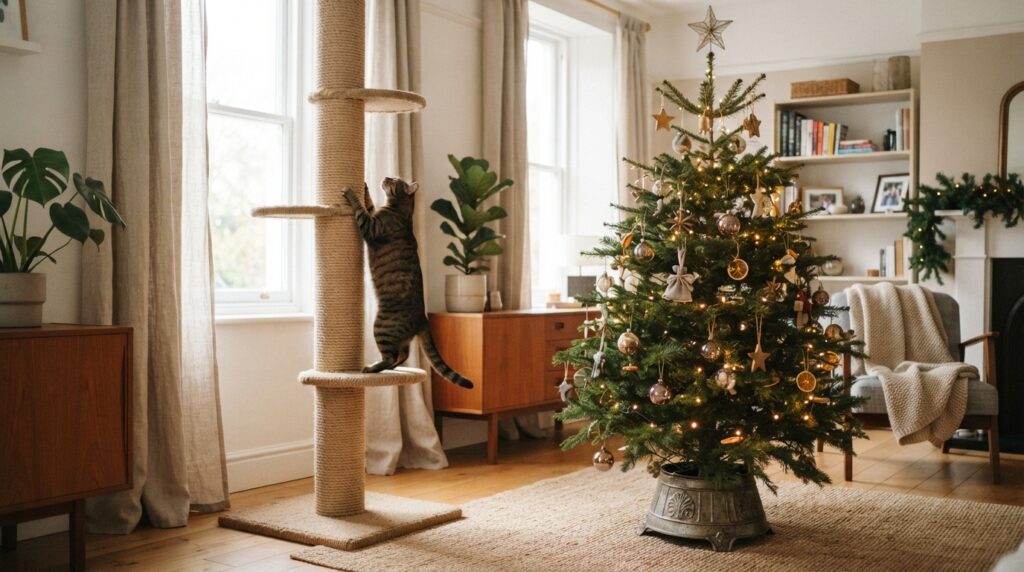
Place a climbing option away from the tree and its ornaments, then reward your cat for using it. This gives climbing behavior a safer target instead of relying only on blocking the tree.
For cat furniture for small apartments, an unused corner can provide vertical territory without crowding a walkway. The Corner-Fit Cat Tree has an 18″ x 18″ base and stands 58″ high, with a shape designed to tuck flush into walls and fit unused corners. Position it where your cat can use it without jumping toward the Christmas tree.
Thinking through how to create a cat corner in a small apartment can help you keep climbing, resting, and play areas distinct from the holiday setup. Choose the alternative for your cat’s habits and the space you have, since a tabletop or raised tree may still be within reach.
Consider vertical alternatives when floor space is tight
Wall-mounted perches can save floor space, but install them into wall studs and plan a route well away from the Christmas tree.
An over-the-door climbing system uses no floor space, but its position still matters. The Over-the-Door Climbing Tower uses no floor space and stands 68″ high.
Keep either alternative away from the tree so it doesn’t become a route to ornaments or cords. These small apartment pet furniture ideas work best when your cat has a clear, appealing route to climb and the tree remains out of reach; simply raising a tree or choosing a tabletop version may not prevent access.
Respond quickly to chewing or suspected ingestion
If your cat may have swallowed tinsel, ribbon, needles, or pieces of an ornament, contact a veterinarian promptly. Don’t pull a visible string or ribbon from your cat’s mouth or body, since pulling can cause further injury.
If your cat has chewed an electrical cord, separate the cat from the power source without touching an energized cord, then seek urgent veterinary advice. Burns, weakness, breathing trouble, or unusual behavior make the situation especially urgent.
Keep the item or a photo of it available so you can describe what your cat may have chewed or swallowed. Prevent further access while you arrange veterinary guidance.
Frequently Asked Questions
Do cats usually stop climbing Christmas trees as they get older?
Some cats become less interested in climbing as their activity changes, but age alone doesn’t guarantee that a cat will avoid a Christmas tree. A sudden change in jumping or climbing may also reflect discomfort, so discuss it with a veterinarian if you notice other signs of pain or mobility trouble.
Are flocked Christmas trees safe for cats?
Flocking can shed when branches are touched or chewed, so keep your cat from nibbling the coating and clear loose material from the floor. If your cat eats any, contact a veterinarian and describe the material and amount as best you can.
Can I leave my cat alone with the tree after several calm supervised visits?
Calm behavior during supervised visits doesn’t show how your cat will respond when no one is nearby. Consider your cat’s past chewing and climbing behavior, and use a closed room or secure barrier if you can’t prevent access to hazards.
What should I do if my cat keeps bypassing a Christmas tree barrier?
Watch how your cat gets around it, then change the layout so the barrier blocks that specific route rather than adding a taller obstacle in the same place. If you can’t make access reliable, move the tree to a room you can close off.
How can I introduce a Christmas tree to a nervous cat?
Let your cat explore the room while the tree is unlit and undecorated, with an easy path to leave and a familiar resting spot nearby. Add decorations in stages and pause if your cat shows persistent hiding, agitation, or avoidance.
What are some safe alternatives to Christmas trees for cats?
Offer a cat tree, wall-mounted perches, or a climbing system placed well away from the holiday decorations. Make sure the alternative is securely installed and gives your cat a clear, appealing route to climb without leading toward hazards.
How can I prevent my cat from climbing my Christmas tree?
Place the tree away from furniture and other surfaces your cat can use as launch points, and use a closed room or a stable barrier to restrict access when you can’t supervise. Secure the tree, keep tempting decorations out of reach, and redirect climbing to an appealing cat tree or perch nearby.
Conclusion
Cats and Christmas Trees: Safer Placement, Stable Bases, and Climbing Alternatives come down to managing the full setup, not relying on one stand, barrier, or tree material. Choose a spot with fewer launch points, anchor and test the tree, keep hazards out of reach, and redirect climbing toward a useful alternative that fits your home and your cat.